
| Unique ID | Title and Description |
|---|---|
pdtdbl00052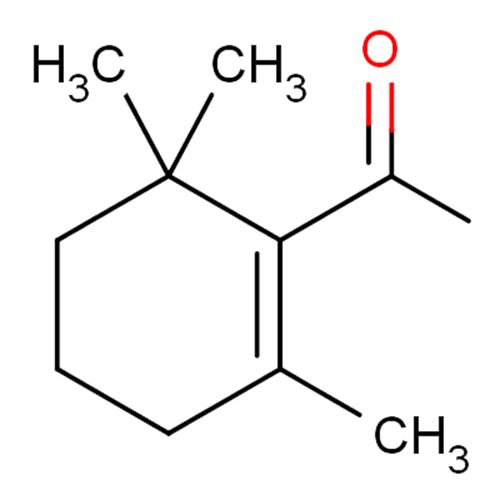 |
beta-Cyclocitral () β-Cyclocitral is a pale to yellow liquid that has an assay of 85 - 90% β-Cyclocitral and 3 - 10% α-Cyclocitral. β-Cyclocitral is formed by Cyanobacteria in reservoirs or water distribution systems. It imparts an aromatic odour to water, reminiscent of hay or dry wood at low concentrations, becoming more tobacco-like and fruity at higher concentrations. |
pdtdbl00134 |
beta-Thujone () Thujone is a ketone and a monoterpene that occurs naturally in two diastereomeric forms: (-)-α-thujone and (+)-β-thujone. It has a menthol odor. Though it is best known as a chemical compound in the spirit absinthe, absinthe contains only small quantities of thujone, so thujone is unlikely to be responsible for absinthe's alleged psychedelic effects. Thujone acts on GABA and 5-HT3 receptors in the brain. In many countries, the amount of thujone allowed in food or drink products is regulated. Thujone, as a component of several essential oils, is also used in perfumery. In addition to the naturally occurring (-)-α-thujone and (+)-β-thujone, two other enantiomeric forms are possible: (+)-α-thujone and (-)-β-thujone. Thujone is found in a number of plants, such as arborvitae (genus Thuja, hence the derivation of the name), Nootka cypress, some junipers, mugwort, oregano, common sage, tansy, and wormwood, most notably grand wormwood (Artemisia absinthium), usually as a mix of isomers in a 1:2 ratio. It is also found in various species of Mentha (mint). |
pdtdbl00221 |
Camphor () Camphor used to be made by distilling the bark and wood of the camphor tree. Today, camphor is chemically manufactured from turpentine oil. It is used in products such as Vicks VapoRub.
Camphor products can be rubbed on the skin (topical application) or inhaled. Be sure to read the label to find out how the product should be administered.
People use camphor topically to relieve pain and reduce itching. It has also been used to treat fungal infections of the toenail, warts, cold sores, hemorrhoids, and osteoarthritis. Camphor is used topically to increase local blood flow and as a “counter irritant,†which reduces pain and swelling by causing irritation. It is important not to apply camphor to broken skin, because it can enter the body quickly and reach concentrations that are high enough to cause poisoning. Some people use camphor topically to treat respiratory tract diseases and to treat heart disease symptoms. Camphor is also used topically as an ear drop, and for treating minor burns. Some people inhale camphor to reduce the urge to cough. Although it is an UNSAFE practice, some people take camphor by mouth to help them cough up phlegm, for treating respiratory tract infections, and for intestinal gas (flatulence). Experts warn against doing this because, when ingested, camphor can cause serious side effects, even death. Camphor is a well-established folk remedy, and is commonly used. Camphorated oil (20% camphor in cottonseed oil) was removed from the U.S. market in the 1980s because of safety concerns. It continues to be available without a prescription in Canada. |
pdtdbl00147 |
Fenchone () Fenchone is a natural organic compound classified as a monoterpene and a ketone. It is a colorless oily liquid. It has a structure and an odor similar to those of camphor. Fenchone is a constituent of absinthe and the essential oil of fennel. Fenchone is used as a flavor in foods and in perfumery. |
pdtdbl00100 |
Geranial () Citral is a clear yellow colored liquid with a lemon-like odor. Less dense than water and insoluble in water. Toxic by ingestion. Used to make other chemicals. Citral is present in the oils of several plants, including lemon myrtle, Litsea citrata, Litsea cubeba, lemongrass, lemon tea-tree, Ocimum gratissimum, Lindera citriodora, Calypranthes parriculata, petitgrain, lemon verbena, lemon ironbark, lemon balm, lime, lemon, and orange. Geranial has a strong lemon odor. Neral's lemon odor is less intense, but sweeter. Citral is therefore an aroma compound used in perfumery for its citrus effect. Citral is also used as a flavor and for fortifying lemon oil. It also has strong antimicrobial qualities, and pheromonal effects in insects. |
pdtdbl00190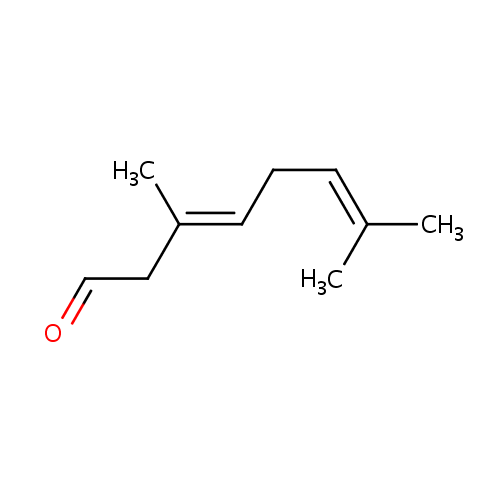 |
Isogeranial () Isogeranial belongs to the class of organic compounds known as acyclic monoterpenoids. These are monoterpenes that do not contain a cycle. |
pdtdbl00185 |
Neral () Citral, also known as Geranial (Citral A) or Neral (Citral B), occurs in the volatile oils of lemon grass, lemon, orange, limetta, and pimento. It is one of the main characteristic flavours in the citrus family besides limonene. Geranial has a strong lemon odor. Neral's lemon odor is less intense, but sweeter. Citral B (cis form) is a terpene aldehyde, colorless liquid, components of many essential oils. |
pdtdbl00158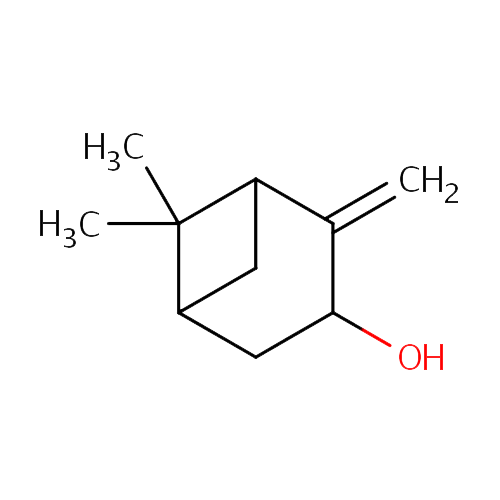 |
Pinocarveol () Pinocarveol is found in hyssop. Pinocarveol is a flavouring ingredient. Pinocarveol belongs to the family of Bicyclic Monoterpenes. These are monoterpenes containing exactly 2 rings, which are fused to each other. |
pdtdbl00129 |
Pulegone () Pulegone is a naturally occurring organic compound obtained from the essential oils of a variety of plants such as Nepeta cataria (catnip), Mentha piperita, and pennyroyal. It is classified as a monoterpene. Pulegone is a clear colorless oily liquid and has a pleasant odor similar to pennyroyal, peppermint and camphor. It is used in flavoring agents, in perfumery, and in aromatherapy. |
for the query 'C10H16O'
PDTDB by Dr. T. Ashok Kumar is licensed under a Creative Commons Attribution-NonCommercial-ShareAlike 4.0 International License.
Copyright © 2009 - 2026 BioGem.Org | Designed and maintained by Dr. T. Ashok Kumar
Last Modified on 20 June 2018
