
| Unique ID | Title and Description |
|---|---|
pdtdbl00174 |
alpha-Bergamotene () A sesquiterpene consisting of a bicyclo[3.1.1]hept-2-ene skeleton substituted at positions 2 and 6 by methyl groups and at position 6 by a 4-methylpent-3-en-1-yl group. |
pdtdbl00131 |
alpha-Cadinene () Cadinene is the trivial chemical name of a number of isomeric hydrocarbons that occur in a wide variety of essential oil-producing plants. The name is derived from that of the Cade juniper (Juniperus oxycedrus L.), the wood of which yields an oil from which cadinene isomers were first isolated. |
pdtdbl00132 |
alpha-Copaene () Copaene, or more precisely, α-copaene, is the common (or trivial) chemical name of an oily liquid hydrocarbon that is found in a number of essential oil-producing plants. The name is derived from that of the resin-producing tropical copaiba tree, Copaifera langsdorfii, from which the compound was first isolated in 1914. Its structure, including the chirality, was determined in 1963. The double-bond isomer with an exo-methylene group, β-copaene, was first reported in 1967. Chemically, the copaenes are tricyclic sesquiterpenes. The molecules are chiral, and the α-copaene enantiomer most commonly found in higher plants exhibits a negative optical rotation of about −6°. The rare (+)-α-copaene is also found in small amounts in some plants. It is of economic significance because it is strongly attracting to an agricultural pest, the Mediterranean fruit fly Ceratitis capitata. |
pdtdbl00179 |
alpha-Cubebene () α-Cubebene is found in cloves. α-Cubebene is a constituent of oil of cubeb pepper (Piper cubeba). |
pdtdbl00180 |
alpha-Humulene () Humulene, also known as α-Humulene or α-Caryophyllene, is a naturally occurring monocyclic Sesquiterpene. It was first found in the essential oils of Humulus lupulus (hops), from which it derives its name. Humulene has been found to produce anti-inflammatory effects in mammals, and has potential to be a tool in the management of inflammatory diseases. It produces similar effects to dexamethasone, and was found to decrease the edema formation caused by histamine injections. Humulene produced inhibitory effects on tumor necrosis factor-α (TNFα) and interleukin-1 β (IL1B) generation in carrageenan-injected rats. |
pdtdbl00213 |
alpha-Selinene () α-Selinene is found in alcoholic beverages. α-Selinene occurs in celery oil and hop (Humulus lupulus) oil. α-Selinene belongs to the family of Sesquiterpenes. These are terpenes with three consecutive isoprene units. |
pdtdbl00149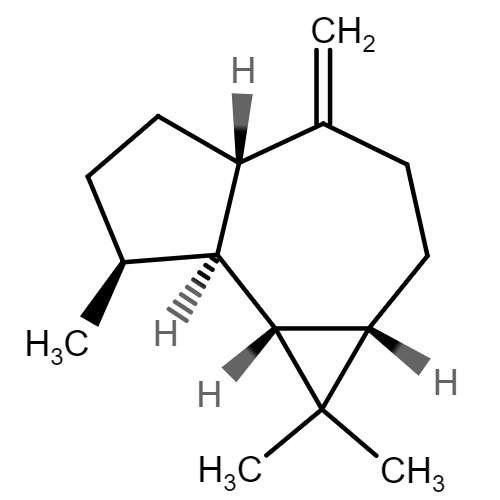 |
Aromadendrene () A sesquiterpenoid hydrocarbon occurring as a major constituent of oils from several eucalyptus trees. |
pdtdbl00181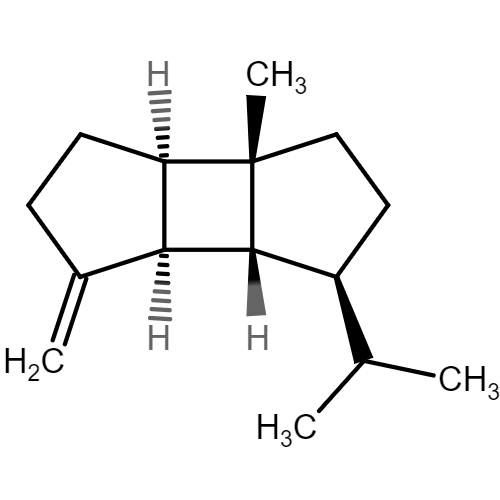 |
beta-Bourbonene () β-Bourbonene is found in cloves. β-Bourbonene is a flavouring agent. |
pdtdbl00170 |
beta-Caryophyllene () Caryophyllene, or (−)-β-Caryophyllene, is a natural bicyclic sesquiterpene that is a constituent of many essential oils, especially clove oil, the oil from the stems and flowers of Syzygium aromaticum (cloves), the essential oil of hemp Cannabis sativa, rosemary Rosmarinus oficinalis, and hops. It is usually found as a mixture with isocaryophyllene (the cis double bond isomer) and α-Humulene (obsolete name: α-Caryophyllene), a ring-opened isomer. Caryophyllene is notable for having a cyclobutane ring, a rarity in nature. |
pdtdbl00096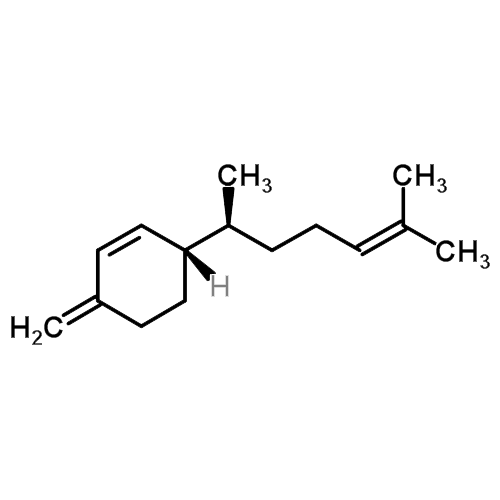 |
beta-Sesquiphellandrene () β-sesquiphellandrene is a sesquiterpene that is cyclohexene in which the hydrogens at position 6 are replaced by a methylidene group and in which the pro-R hydrogen at position 3 is replaced by a (2S)-6-methylhept-5-en-2-yl group. |
pdtdbl00097 |
Bisabolene () Bisabolenes are a group of closely related natural chemical compounds which are classified as sesquiterpenes. Bisabolenes are present in the essential oils of a wide variety of plants including cubeb, lemon and oregano. Various derivates also function as pheromones in different insects, such as stink bugs and fruit flies. Bisabolenes are intermediates in the biosynthesis of many other natural chemical compounds, including hernandulcin, a natural sweetener. β-Bisabolene has a balsamic odor and is approved in Europe as a food additive. |
pdtdbl00186 |
delta-Cadinene () δ-Cadinene is a member of the cadinene family of sesquiterpenes in which the double bonds are located at the 4-4a and 7-8 positions, and in which the isopropyl group at position 1 is cis to the hydrogen at the adjacent bridgehead carbon (the 1S,8aR-enantiomer). |
pdtdbl00098 |
Farnesene () The term farnesene refers to a set of six closely related chemical compounds which all are sesquiterpenes. α-Farnesene and β-farnesene are isomers, differing by the location of one double bond. α-Farnesene is 3,7,11-trimethyl-1,3,6,10-dodecatetraene and β-farnesene is 7,11-dimethyl-3-methylene-1,6,10-dodecatriene. The alpha form can exist as four stereoisomers that differ about the geometry of two of its three internal double bonds (the stereoisomers of the third internal double bond are identical). The beta isomer exists as two stereoisomers about the geometry of its central double bond. Two of the α-farnesene stereoisomers are reported to occur in nature. (E,E)-α-Farnesene is the most common isomer. It is found in the coating of apples, and other fruits, and it is responsible for the characteristic green apple odour. Its oxidation by air gives compounds that are damaging to the fruit. The oxidation products injure cell membranes which eventually causes cell death in the outermost cell layers of the fruit, resulting in a storage disorder known as scald. (Z,E)-α-Farnesene has been isolated from the oil of perilla. Both isomers are also insect semiochemicals; they act as alarm pheromones in termites or food attractants for the apple tree pest, the codling moth. α-Farnesene is also the chief compound contributing to the scent of gardenia, making up ~65% of the headspace constituents. β-Farnesene has one naturally occurring isomer. The E isomer is a constituent of various essential oils. It is also released by aphids as an alarm pheremone upon death to warn away other aphids. Several plants, including potato species, have been shown to synthesize this pheromone as a natural insect repellent. |
pdtdbl00188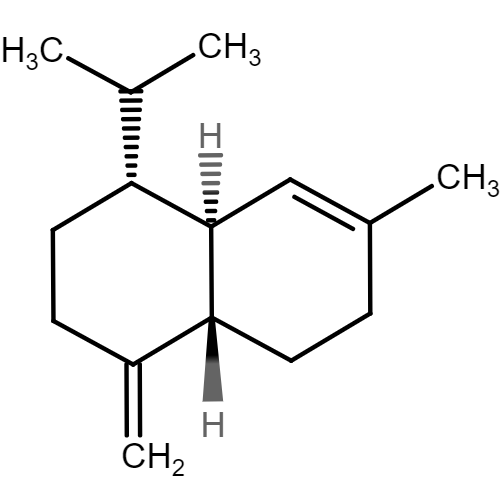 |
gamma-Cadinene () γ-Cadinene is found in allspice. γ-Cadinene is a constituent of citronella oil. |
pdtdbl00187 |
Germacrene D () Germacrenes are a class of volatile organic hydrocarbons, specifically, sesquiterpenes. Germacrenes are typically produced in a number of plant species for their antimicrobial and insecticidal properties, though they also play a role as insect pheromones. Two prominent molecules are Germacrene A and Germacrene D. Germacrene has five isomers - Germacrene A, B, C, D, and E. The essential oil of the red deadnettle (Lamium purpureum) is characterized by its high contents of Germacrene D, as is Clausena anisata. |
pdtdbl00093 |
Zingiberene () Zingiberene is a monocyclic sesquiterpene that is the predominant constituent of the oil of ginger (Zingiber officinale), from which it gets its name. It can contribute up to 30% of the essential oils in ginger rhizomes. This is the compound that gives ginger its distinct flavoring. Zingiberene is formed in the isoprenoid pathway from farnesyl pyrophosphate (FPP). FPP undergoes a rearrangement to give nerolidyl diphosphate. After the removal of pyrophosphate, the ring closes leaving a carbocation on the tertiary carbon attached to the ring. A 1,3-hydride shift then takes place to give a more stable allylic carbocation. The final step in the formation of zingiberene is the removal of the cyclic allylic proton and consequent formation of a double bond. Zingiberene synthase is the enzyme responsible for catalyzing the reaction forming zingiberene as well as other mono- and sesquiterpenes. |
for the query 'C15H24'
PDTDB by Dr. T. Ashok Kumar is licensed under a Creative Commons Attribution-NonCommercial-ShareAlike 4.0 International License.
Copyright © 2009 - 2026 BioGem.Org | Designed and maintained by Dr. T. Ashok Kumar
Last Modified on 20 June 2018
