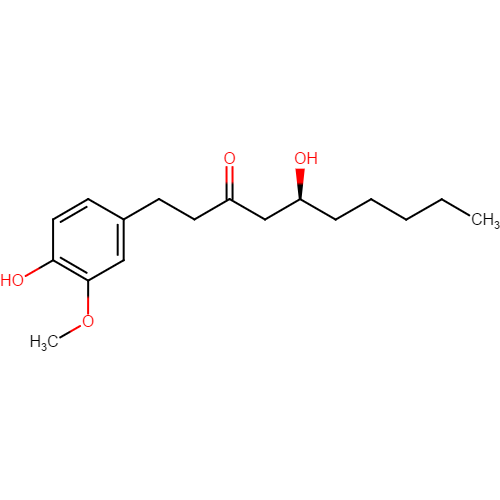
Gingerol, or sometimes [6]-gingerol, is the active constituent of fresh ginger. Chemically, gingerol is a relative of capsaicin and piperine, the compounds which give chilli peppers and black pepper their respective spicyness. It is normally found as a pungent yellow oil, but also can form a low-melting crystalline solid.
Cooking ginger transforms gingerol into zingerone, which is less pungent and has a spicy-sweet aroma. When ginger is dried, gingerol undergoes a dehydration reaction forming shogaols, which are about twice as pungent as gingerol. This explains why dried ginger is more pungent than fresh ginger.
Ginger also contains 8-gingerol, 10-gingerol, and 12-gingerol.
[6]-Gingerol administered by intraperitoneal injection has been used to induce a hypothermic state in rats.
Gingerol seems to be effective in an animal model of rheumatoid arthritis.
Gingerol and its analogues have a favourable toxicity profile, but are cytotoxic towards a range of cancer cell lines including blood cancer and lung cancer.
Gingerol has been investigated in vitro for its effect on cancerous tumors of the bowel, breast tissue, ovaries, and pancreas, with positive results.
The product is sometimes used for gingering of horses, a practice that is seen in the horse show world, and which is illegal in some, but not all disciplines.